

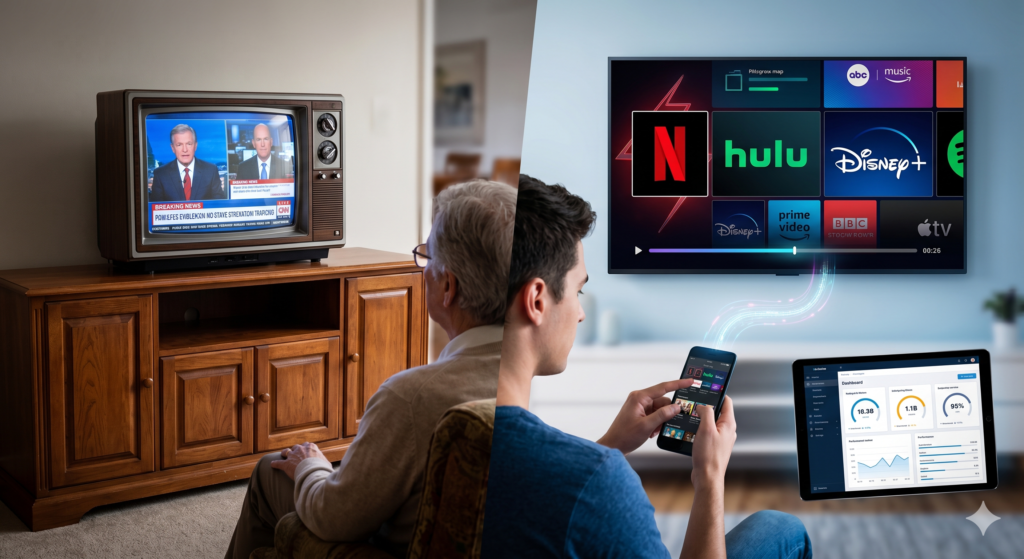
Television advertising is undergoing its most profound transformation since the invention of the remote control. Connected TV (CTV) has moved from challenger to co-pilot — and in many metrics, it’s now firmly in the driver’s seat. At the same time, linear TV isn’t dead. It’s evolving. Understanding both is essential for any brand that wants to win on screen.
The Numbers Tell the Story
Let’s start with the data, because the data is striking.
Streaming now accounts for 47.5% of total U.S. television viewing time — the highest share ever recorded, according to Nielsen’s December 2025 Gauge report. Meanwhile, linear TV (broadcast + cable) has dipped below 50% of total viewing for the first time ever and continues to slide.
CTV ad spend in the U.S. hit $41 billion in 2024, growing 23% year-over-year. Meanwhile, linear TV ad spending is expected to decrease more than 11% globally in 2026, reaching $139.1 billion — a sharp contrast to its $60.56 billion peak just a couple of years ago.
Linear TV’s share of global media spend has collapsed from 41.3% in 2013 to just 12.4% today — a 70% drop in share over 13 years.
CTV: The Performance Channel That Television Never Was
What makes CTV so compelling isn’t just viewership — it’s accountability. Unlike linear TV, CTV offers:
- Precise targeting — audience-based buying rather than broad demographic GRPs
- Measurable outcomes — 65% of marketers now classify CTV as a performance channel, not just an awareness tool
- Higher ROI — CTV advertising ROI averages 4.5x higher than linear TV
- Ad relevance — 63% of viewers find CTV ads more relevant than linear TV ads
- Better recall — consumers recall CTV ads 2.2x better than YouTube pre-roll ads
Nearly half (47%) of advertisers now expect CTV inventory to be biddable — a 13 percentage point increase from 2024 — reflecting the rapid shift toward programmatic activation in streaming environments.
The average U.S. adult is expected to spend 3 hours and 41 minutes watching CTV per day in 2026, a 24.9% increase from 2023.
Linear TV: Down, But Not Out
It would be a mistake to write off linear TV entirely. Here’s why it still earns its place in the media mix:
Unmatched reach at scale. Linear TV still accounts for nearly six times as many ad impressions as CTV. For brands that need to reach mass audiences in a single moment — product launches, seasonal campaigns, cultural moments — nothing competes.
Live sports are king. Over 125.6 million viewers watched Super Bowl LX, the vast majority through linear TV. Live sports events remain one of the most powerful mechanisms for capturing undivided attention, and linear TV owns that territory.
The older audience is still there — and they spend. 42.2% of linear TV viewers in the U.S. are aged 55 and up. Baby boomers watch nearly 4 hours of linear TV per day — nearly 90 minutes more than Gen X. For brands targeting this demographic, linear remains essential.
The IAB confirms that the average marketer reallocated 36% of their linear TV ad spend to CTV in 2025 — but that still leaves 64% in the linear ecosystem.
The Age Divide Is Real
The demographic split between CTV and linear is stark and growing starker:
| Age Group | % of TV Time on Linear (2025) |
|---|---|
| 18–24 | ~18% |
| 50–64 | ~63% |
| 65+ | Majority |
Gen Alpha CTV viewership is projected to grow 6.5% year-over-year in 2026, creating powerful new opportunities for brands targeting younger consumers with growing spending power.
The Convergence Era: Planning Across Both Screens
The smartest advertisers in 2026 aren’t choosing between CTV and linear — they’re converging them. The new framework is total video planning: building reach and frequency strategies that span both ecosystems using unified audience-based tools.
What this looks like in practice:
- Unified reach planning — teams are moving away from siloed TV and digital departments, planning total video reach across screens together
- Cross-screen frequency control — avoiding the same household being hit with the same message on linear and then on three different CTV apps
- Holistic reporting — measuring deduplicated reach across platforms, not isolated reports for each channel
Vertical video is also entering the CTV ecosystem, with platforms experimenting with TikTok-style feeds inside their streaming apps. It’s not replacing CTV — it’s becoming the entry point into longer viewing sessions.
Ad-Supported Streaming: The Growth Engine
One of the clearest trends in 2026 is the explosive growth of ad-supported streaming tiers. By Q1 2025, ad-supported subscriptions accounted for 57% of all new subscriber additions, with nearly half of total streaming subscriptions now ad-supported.
Netflix’s ad tier has over 40 million monthly active users. Disney+ with Ads reaches 25 million ad-tier subscribers globally. Tubi, Pluto TV, and free ad-supported TV (FAST) channels are growing rapidly.
For advertisers, this expansion is a gift: premium content environments, engaged audiences, and targeting precision — all in one place.
What This Means for Your Brand
The television advertising landscape has never been more complex — or more full of opportunity. Here’s the simple framework:
Use CTV for:
- Performance goals (web visits, conversions, app installs)
- Younger, cord-cutting audiences
- Precision targeting and real-time optimization
- Measurement and attribution
Use Linear for:
- Mass reach and brand awareness
- Live events and cultural moments
- Reaching audiences 55+
- High-impact national campaigns
Use both together for:
- Everything else
At Edworld Advertising, we help brands navigate this dual-screen world with strategies built for how audiences actually watch — not how they used to. The television advertising playbook has been rewritten. Let’s write yours.