

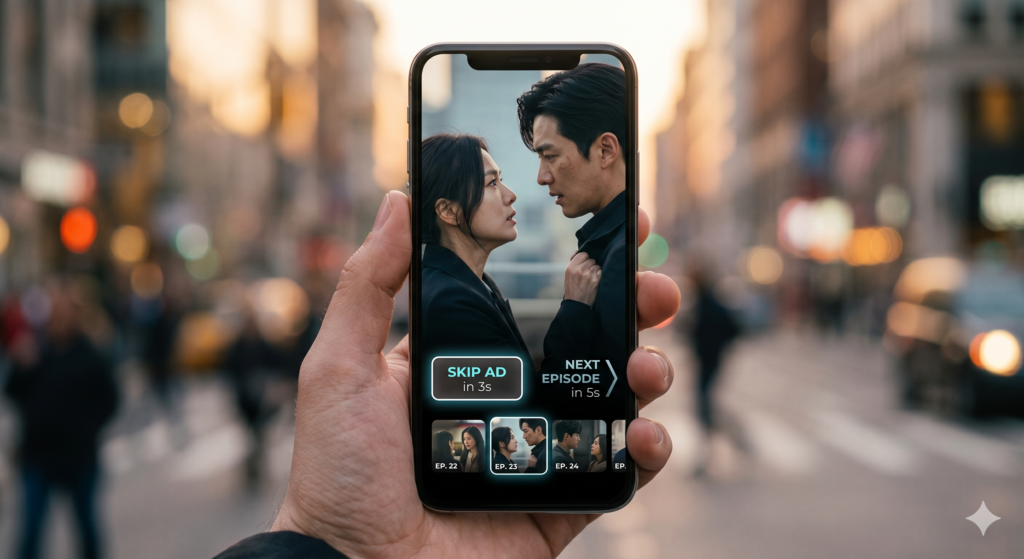
Imagine a TV show condensed into 90 seconds. Each episode ends on a cliffhanger. You watch one, then another, then ten more — and somehow an hour has passed. Welcome to the world of micro dramas, the fastest-growing content format on the planet, and the most exciting new advertising frontier since social media.
This isn’t a niche trend. It’s a multi-billion dollar industry in the making — and brands that understand it now will have a significant head start.
What Exactly Is a Micro Drama?
Micro dramas (also called short dramas) are serialized, scripted short-form videos — typically 1 to 3 minutes per episode — designed for mobile-first consumption. They borrow the emotional hooks of traditional TV drama (romance, revenge, power, betrayal) but deliver them in bite-sized installments perfectly optimized for TikTok, Instagram, YouTube Shorts, and dedicated apps like ReelShort and DramaBox.
The format is built on a simple psychological principle: the cliffhanger. Every episode ends just before the resolution. Viewers pay — or watch ads — to find out what happens next.
The Scale Is Staggering
The numbers behind micro drama’s growth are hard to believe until you look at the data:
- Global micro drama revenues hit $11 billion in 2025, according to Omdia — nearly twice the size of the entire free ad-supported streaming (FAST) television market
- Short drama apps were the fastest-growing app segment in 2025, with downloads up 278% year-on-year — ahead of even AI applications (Sensor Tower)
- In-app revenue for the category grew 115% year-on-year
- In Q3 2025 alone, micro dramas generated $800 million in global revenues (excluding China), doubling from $400 million in Q3 2024
- Deloitte projects the format will generate $7.8 billion in revenue in 2026 from social-first series alone
- The Motion Picture Association forecasts the global micro drama market to grow from $1.4 billion in 2024 to $9.5 billion by 2030, at a CAGR of 28%
For context: in Q4 2025, short drama downloads surpassed traditional OTT streaming downloads, which declined 7% in the same period.
China Led the Way. The World Is Following.
Micro drama originated in China, where it evolved from experimental mobile content into a cultural juggernaut. Chinese micro drama revenues skyrocketed from $500 million in 2021 to $7 billion in 2024, and are projected to reach $16.2 billion by 2030. In 2025, micro drama revenues in China surpassed the country’s entire local theatrical box office.
Outside China, the United States leads international markets, with $819 million in revenues in 2024, projected to climb to $3.8 billion by the end of the decade. Japan is positioning as the largest Asia-Pacific market outside China, with revenues forecast to top $1.2 billion by 2030.
India represents one of the most exciting emerging markets. India’s micro drama market crossed $300 million in its first year of meaningful scale, amassing 450 million downloads and 100 million monthly active users (Lumikai State of India Interactive Media 2025 report).
Why Advertisers Are Taking Notice
Here’s what makes micro dramas different from every other content format from an advertising perspective: people actually want to watch them.
Traditional advertising interrupts. Micro drama advertising integrates. Brands aren’t building campaigns around these stories — they’re becoming part of the stories.
68% of total U.S. micro drama app spending came from social media between January and September 2025, with Facebook taking the largest share (25%), followed by TikTok (19%), Snapchat (16%), and Instagram (8%).
Major broadcasters are taking notice. TelevisaUnivision offered sponsorships tied to 30 micro drama titles during their 2025 upfront market, with plans to increase investment to up to 100 original projects in 2026. The company reports that brands are proactively approaching them — because “we know a trend when we see it.”
The New Rules of Brand Storytelling
Micro dramas are doing something remarkable: they’re making advertising feel like content. And that shift has profound implications for how brands think about storytelling.
The product doesn’t lead — it lives in the scene. In micro drama brand integrations, products appear naturally within the narrative. A character uses a skincare product in their morning routine. A couple discusses finances while using a fintech app. The audience notices without being told to notice — and that frictionless integration is far more persuasive than any traditional product placement.
Serialization creates habit. Unlike a single ad or even a campaign, micro dramas keep audiences coming back episode after episode. That sustained engagement compounds brand familiarity in ways that one-off spots simply cannot.
The creative formula is disciplined. High-performing micro drama ads share a common structure: hook in the first 3 seconds, establish emotional stakes quickly, resolve or escalate within the episode. This discipline improves completion rates and aligns with platform algorithms that reward engagement.
The Advertiser Ecosystem Is Exploding
By the end of 2025, there were over 700 monthly active micro drama app advertisers, with 63.61% year-over-year growth. Monthly creative output per advertiser increased by 144.9% YoY — signaling that brands are not just testing the format, they’re scaling it aggressively.
For agencies and brand teams, this creates both opportunity and a challenge: volume of creative is increasing, but quality and emotional resonance remain the differentiator.
What This Means for Indian Brands
India is at a pivotal inflection point with micro dramas. With 450 million downloads and 100 million monthly active users already, the infrastructure is in place. What’s missing is a coordinated brand strategy.
The audiences consuming micro dramas in India skew young, mobile-first, and highly engaged — exactly the demographics brands have been trying to reach through increasingly expensive social media advertising. Micro dramas offer a fresh, less cluttered environment to tell brand stories with emotional depth and serial engagement.
For brands that act early, the cost of entry is still relatively low. The window won’t stay open long.
The Bottom Line
Micro dramas represent the convergence of everything that works in modern media: short-form urgency, serialized storytelling, mobile-first consumption, and high emotional engagement. They’re growing faster than AI apps. They’re generating more revenue than FAST channels. And they’re creating entirely new ways for brands to connect with audiences.
This is not a trend to watch. It’s a trend to act on.
At Edworld Advertising, we’re already helping brands explore micro drama storytelling strategies. If you want to be part of this format before it becomes mainstream, now is the moment.