

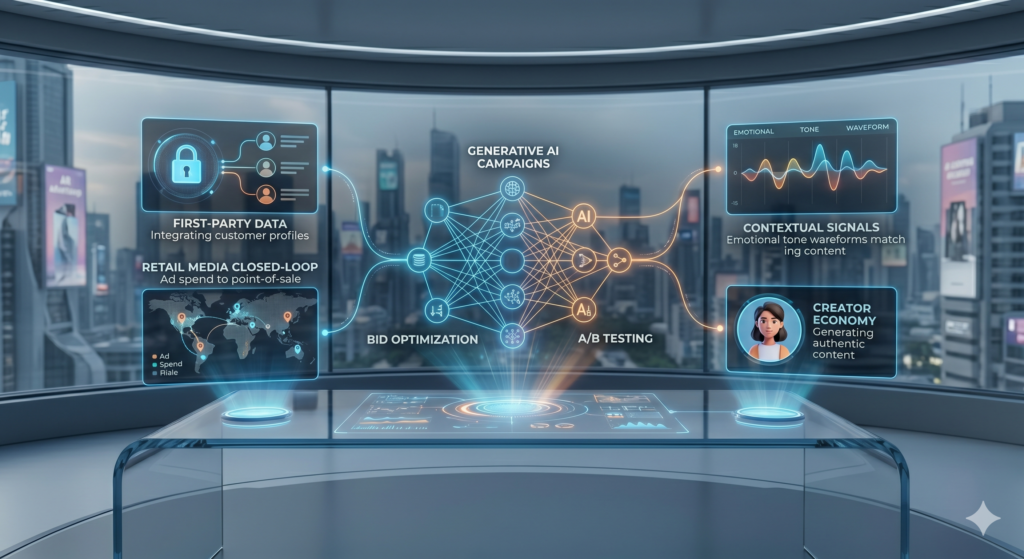
The advertising industry doesn’t slow down — it reinvents itself. And right now, we’re living through one of the most significant reinventions in decades. From AI-powered campaign management to the death of the third-party cookie, the rules of the game are changing fast. Here’s a look at the trends every brand and advertiser needs to understand today.
1. The Industry Is Growing — Faster Than Ever
Let’s start with the big picture. The global advertising services market is expected to leap from $1.03 trillion in 2025 to $1.23 trillion in 2026, and is forecast to reach $2.33 trillion by 2031 at a CAGR of 13.63%. This isn’t just momentum — it’s structural growth, driven by digital transformation, mobile proliferation, and the rise of performance-driven channels.
Digital advertising now commands over 61% of total ad spend globally, with programmatic video, retail media networks, and social commerce leading the charge.
2. AI Is No Longer Optional — It’s Infrastructure
Artificial intelligence has moved from buzzword to backbone. In 2026, generative AI is embedded in every part of the advertising lifecycle — from creative ideation and copywriting to media buying, bid optimization, and real-time A/B testing.
Over 56% of marketers already use AI for campaign management, and the number is climbing. AI tools can spin out campaign structures in seconds, optimize bids in milliseconds, and adapt creative based on audience signals. But here’s the nuance: AI handles the scaffolding, not the soul. Human strategy and brand judgment remain irreplaceable.
Marketers who use AI as a force multiplier — not a replacement — will win.
3. First-Party Data Is the New Gold
The era of third-party cookies is effectively over. Privacy regulations across Europe and beyond have reshaped how advertisers collect, own, and activate audience data. The shift is clear: brands that built proprietary first-party data platforms are now operating from a position of strength.
Clean rooms, loyalty programs, and direct consumer relationships are becoming the foundation of modern targeting. Advertisers are no longer renting audiences — they’re building them.
What to do: Invest in zero-party and first-party data infrastructure now. Offer genuine value — personalization, loyalty perks, exclusive access — in exchange for consumer data.
4. Retail Media Is Rewriting the Playbook
Retail media — advertising on platforms like Amazon, Walmart Connect, and Flipkart — is one of the fastest-growing segments in digital advertising, expanding at a 13.73% CAGR. Why? Because it offers something traditional digital advertising never could: closed-loop attribution at the point of purchase.
Advertisers no longer have to guess whether an ad led to a sale. Retail media platforms know. This measurability is pulling budgets away from attention-based platforms and toward transactional ones.
5. Contextual Advertising Is Making a Comeback
As identity signals disappear, contextual advertising — matching ads to the mood, genre, and narrative of the content surrounding them — is experiencing a renaissance. This isn’t the blunt contextual targeting of the early 2000s. Today’s contextual tools use AI to read emotional tone, narrative arc, and audience intent in real time.
Studies show that ads matched to contextual relevance deliver higher attention, stronger brand recall, and better favorability. It’s privacy-first and performance-driven — a rare combination.
6. The Creator Economy Is Central, Not Peripheral
Brands are no longer choosing between traditional media and creator partnerships — they’re integrating them. Creators have become the most trusted form of media for a growing number of consumers, particularly Gen Z and Gen Alpha.
The shift is visible in budget allocation: creator-led campaigns are moving from the “experimental” line item to core brand strategy. Authenticity is the currency, and creators hold the mint.
7. Efficiency, Accountability, and ROI Above All Else
Perhaps the clearest meta-trend of 2026 is this: every dollar of advertising spend must be justified. Tightening budgets, economic uncertainty, and boardroom pressure have made measurable ROI non-negotiable.
Programmatic video revenue is projected to top $200 billion in 2026. More than 90% of connected-TV impressions already trade programmatically. The message is clear — precision, accountability, and performance are the standards every channel is being held to.
Advertising in 2026 is smarter, faster, and more accountable than ever. The brands and agencies that will thrive are those that embrace AI without losing their human edge, build first-party data assets, and tell stories that resonate across every screen.
At Edworld Advertising, we stay ahead of these shifts so our clients don’t have to chase them. The future is being written now — and we’re here to help you write yours.